

Holes In Guitars
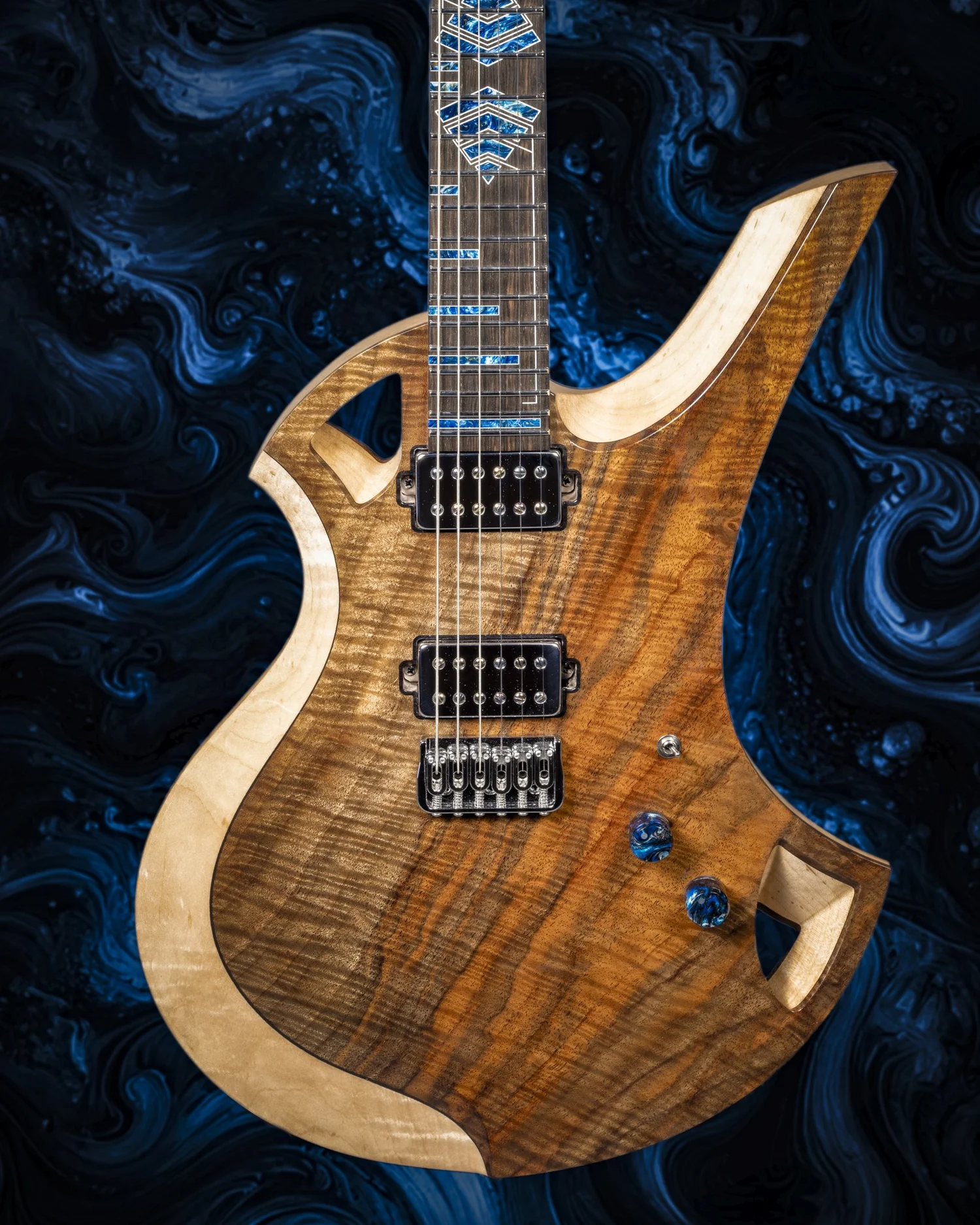
The Scarab is a large body shape, most comparable to something like a Jackson Kelly or an Ibanez Iceman. That size can make it heavy, and I wanted to remove as much weight as I could. Between aggressive arm bevels and the holes through the body, I was able to bring the finished instrument down to around six pounds. Weight relief was the practical reason for adding them, but the way they developed also owes something to my mentor, Rick Turner.
I first encountered a guitar built this way after meeting Rick and seeing his original Pretzel. He built that instrument in early 1969, and it was later exhibited at the Museum of Arts and Design in New York in 2011. To my eye, its flowing shape has an Art Nouveau quality. His approach was far more extreme than what I eventually did with the Scarab: he had removed a tremendous amount of material from inside the body, leaving large areas of open space. Seeing it made me want to explore that direction in my own work.
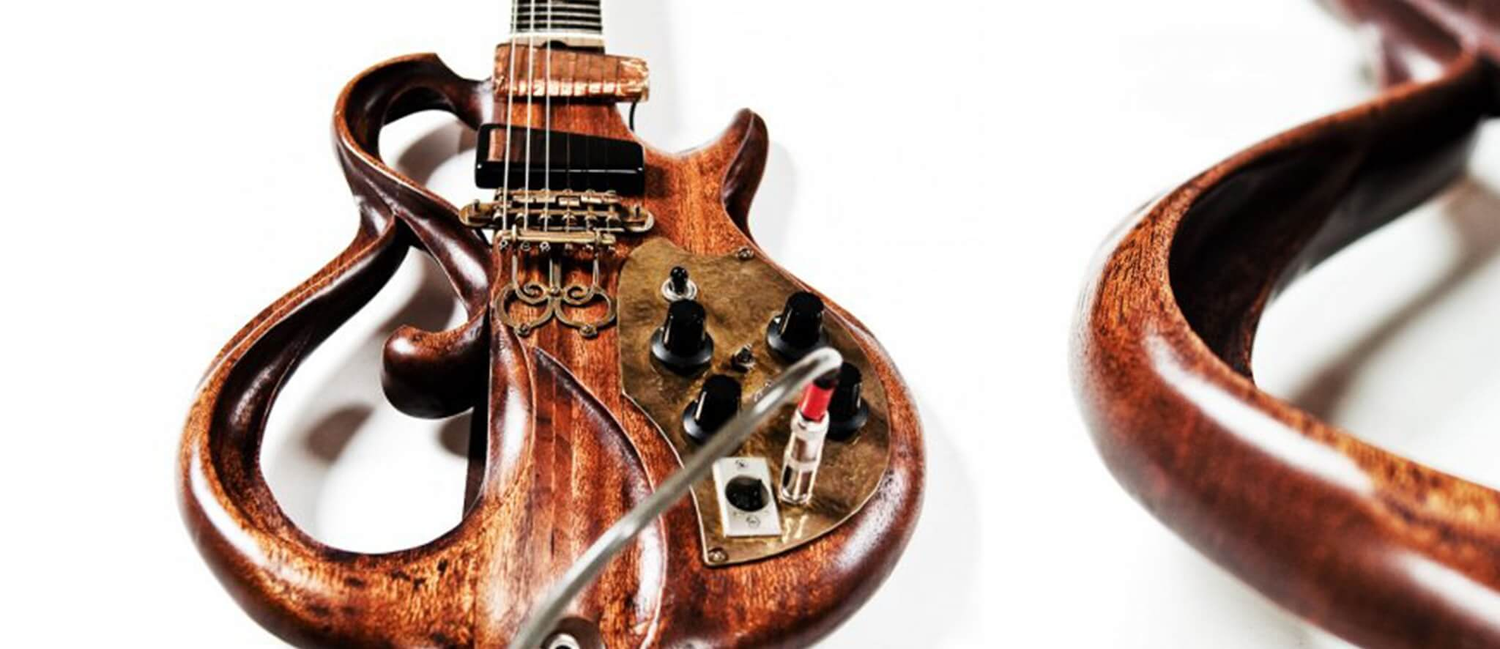
Other makers have also popularized openings in electric guitar bodies, and I was conscious of that when considering how to use them. I wanted to find an application with some originality while acknowledging where my own interest began. Rick’s Pretzel gave me a reference for how extensively a body could be opened up. Seeing it still intact well over forty years later also proved to me that this approach could hold up when built from seasoned hardwoods. The Scarab’s construction gave me a different set of conditions to work through.
My bodies use multiple laminates, and those layers complicate the placement of the holes, particularly where an opening intersects a bevel. I had wanted to take the material removal further, along the lines of what Rick had done, but found that some possibilities became limiting when applied to my construction. The openings had to work with the layers and the carved surfaces already present in the body.
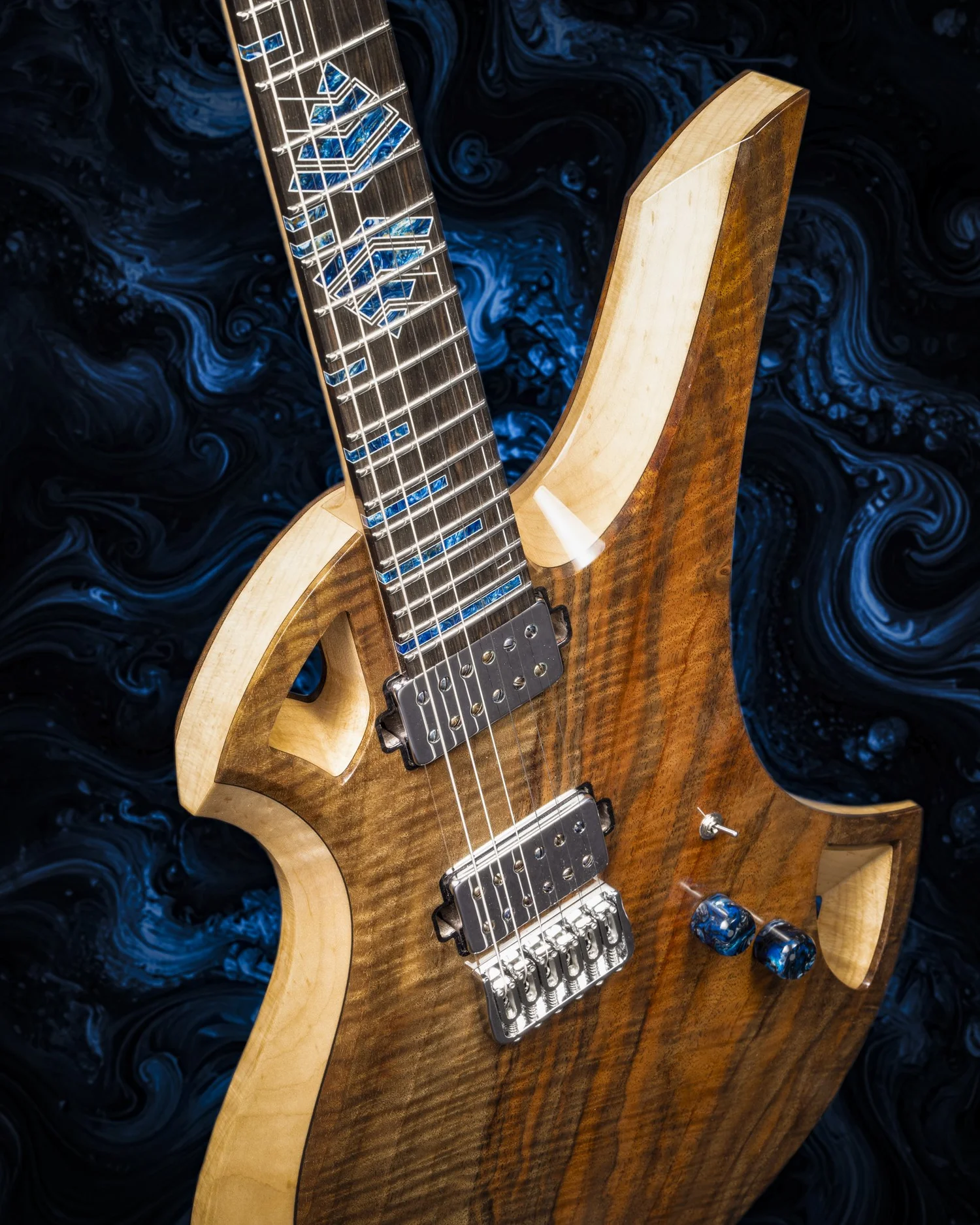
The top and back of the Scarab also have different geometry. In some areas, the inside wall of a hole needed to run parallel to a nearby carve. Elsewhere, I needed to connect an opening on the front to one on the back that was offset and had a completely different shape. Connecting those boundaries meant working out what the surfaces between them would do through the thickness of the guitar.
That is where the twisting geometry came from. As I started playing with those connections in CAD, I found some shapes that were fun to look at. The requirements of the surrounding carve gave the interior surfaces angles and transitions that I wanted to develop further. What began as an effort to remove weight became another part of the guitar’s shape that I enjoyed working on.
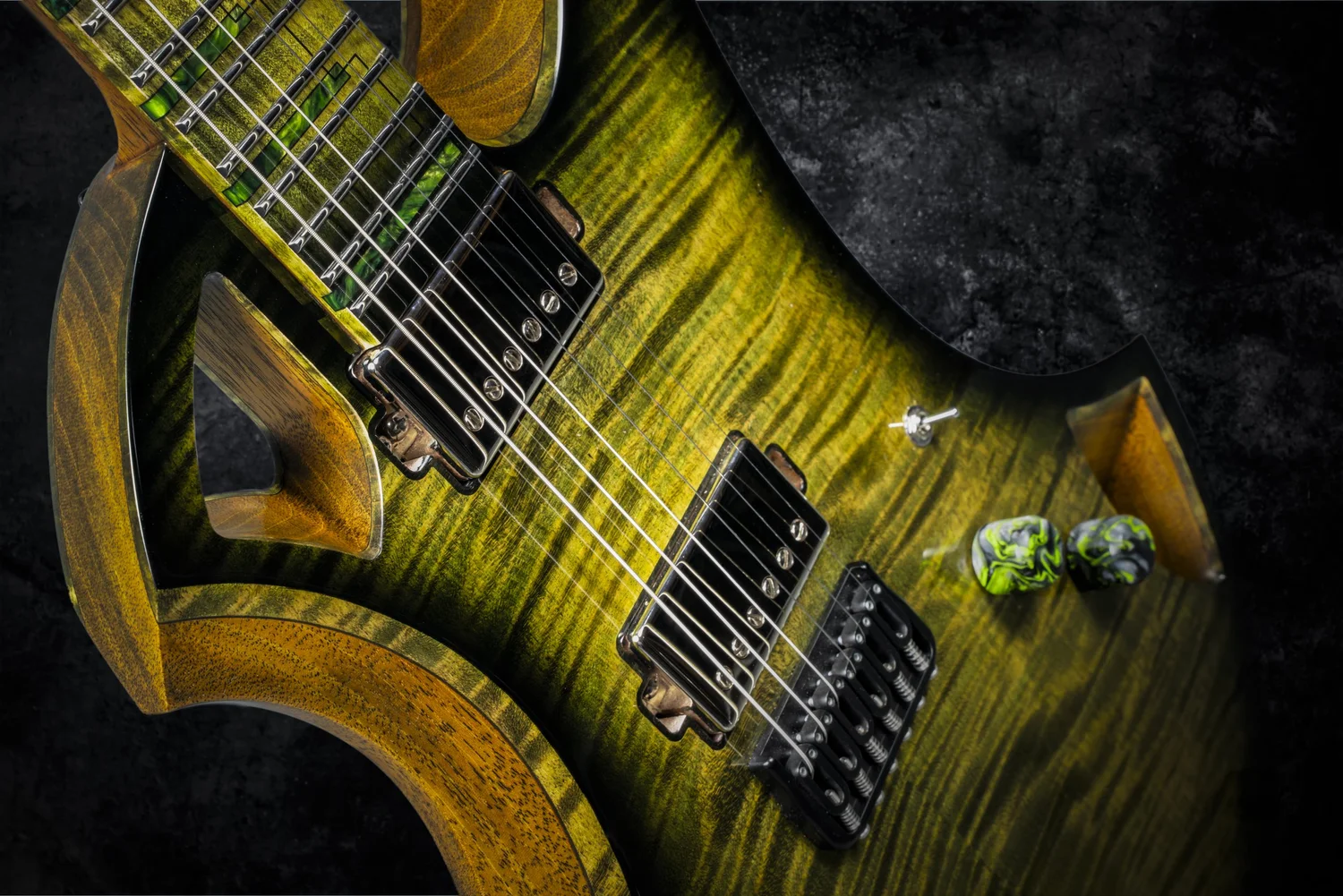
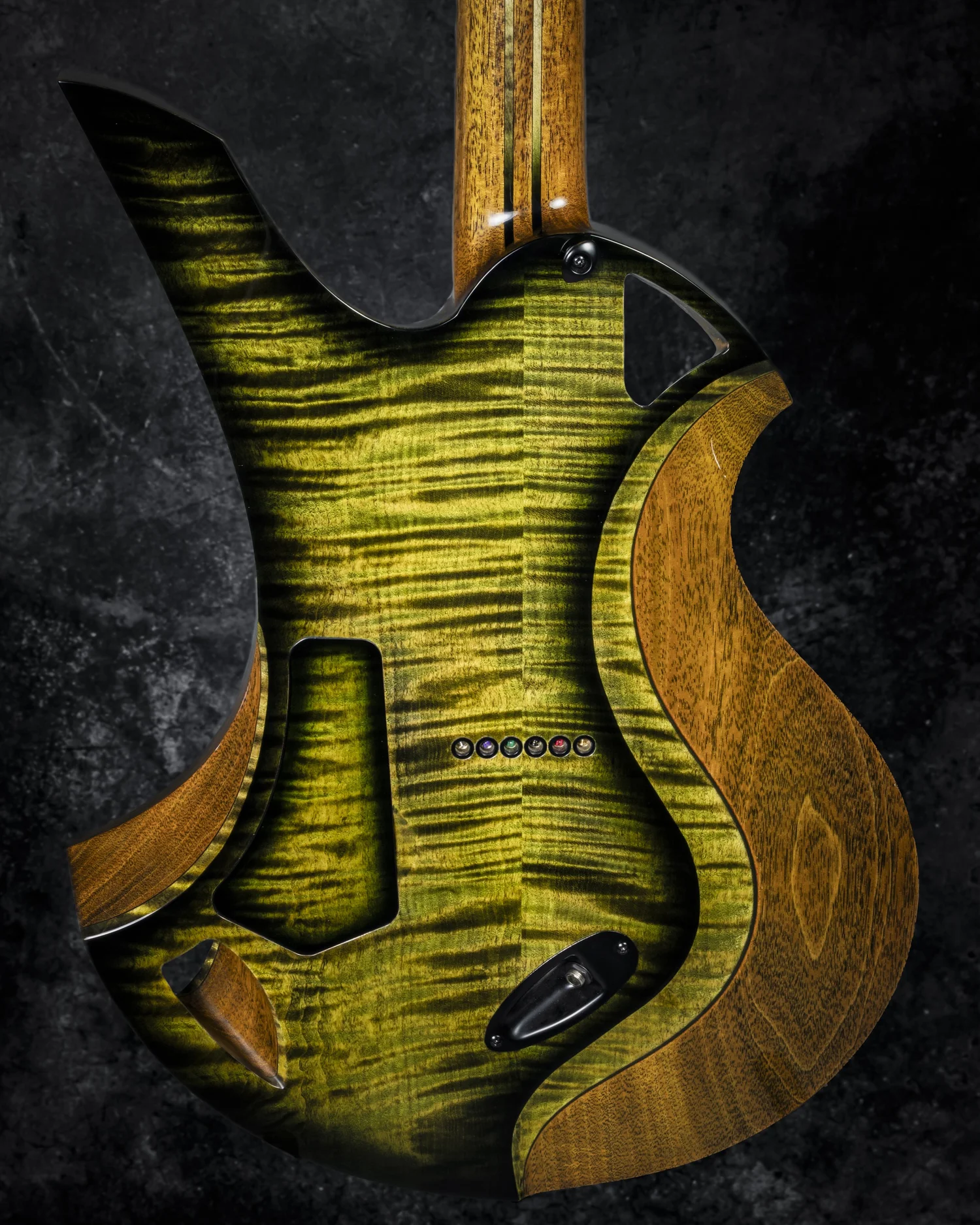
The resulting holes have depth and direction. Their appearance changes as you turn the instrument and see different parts of the surfaces inside them. “Negative space” is a useful term for this because the opening has a shape of its own, and that shape contributes to how the whole body looks. On the Scarab, the relationship between the top and back became an opportunity to give those openings some character.
When I talk about this feature in my guitars, I want people to know about Rick’s work. The Pretzel is part of the history behind an idea that other builders continue to explore, myself included. It was the instrument that introduced me to that possibility, and the Scarab carries that influence through the particular problems I was trying to solve.
