

Why the Famine Guitar and Bass Bodies Are Radiused
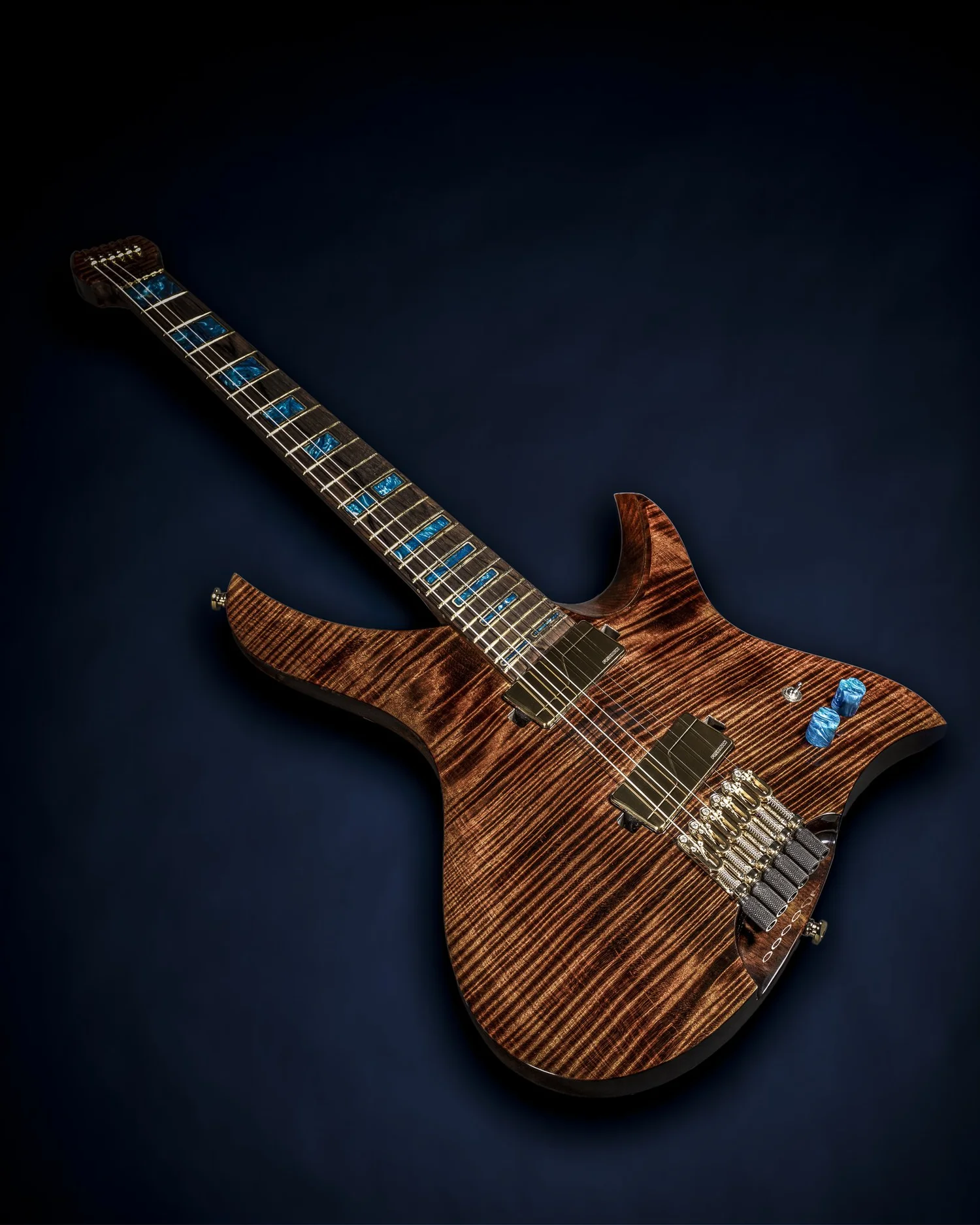
The radiused bodies on the Famine Guitar and Famine Bass came from a mix of geometry, curiosity, and ideas I had already been exposed to while working for Rick Turner.
The first version happened almost by accident. I was drawing a guitar with a compound-radius fretboard and started thinking about what happens to that radius as the geometry continues beyond the end of the board. A compound-radius fretboard is a section of a cone, so the radius keeps increasing as you move farther from the nut. I projected that geometry out to the bridge and checked the number.
It was 23.5 inches.
That immediately caught my attention because curved guitar bodies were already familiar to me. Rick Turner’s Model 1 uses cylindrical top and back surfaces, and I spent years around those instruments while working for him. Rick completed the first Model 1 prototypes in 1979, but he was also very clear that the basic idea had a much older precedent. In his own writing about the development of the Model 1, he referred to “the cylinder topped Howe-Ormes from the 1890s.”
Rick had first encountered Howe-Orme instruments while apprenticing as a repairman in Boston in the 1960s. Their guitars used cylindrical arched tops, and the company’s work dates back to the 1890s. Rick later became very interested in them and carried that idea into his own instruments.
I think that history matters because there is almost nothing new under the sun in guitar design. Almost.
People have been experimenting with stringed instruments for a very long time. Fan frets, unusual scale lengths, adjustable necks, curved surfaces, strange bridge systems, alternative bracing, and all kinds of supposedly modern ideas usually have some older precedent if you look hard enough. That does not make current design less interesting. It just means that the useful part is often in how an old idea is applied, combined with something else, or carried farther with tools that earlier builders did not have.
That is essentially what happened with the Famine.
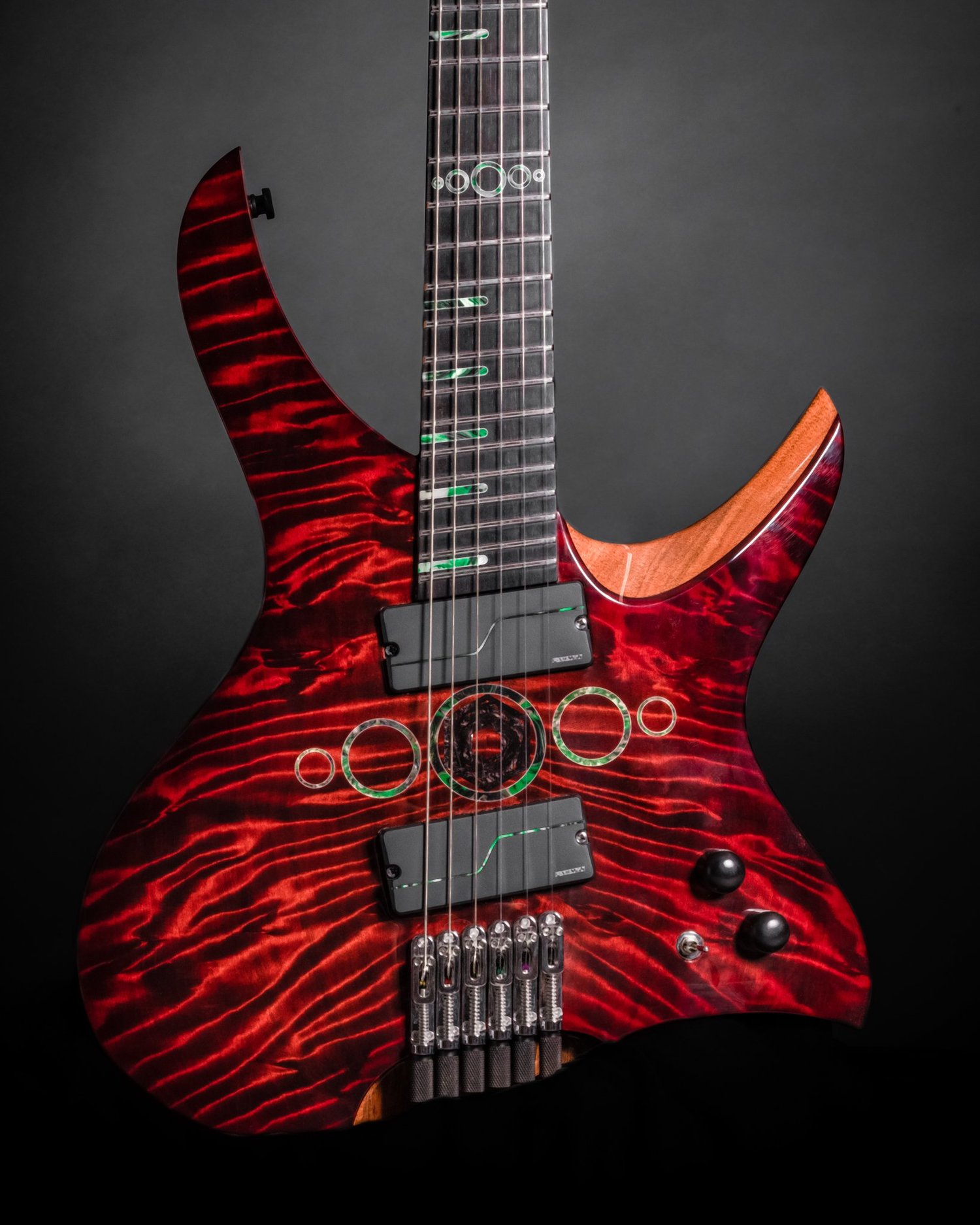
The Famine Guitar
Rick’s Model 1 had already shown me that cylindrical body surfaces worked. What interested me was tying that kind of geometry directly to the fretboard.
Once I knew that my compound-radius fretboard projected to 23.5 inches at the bridge, I decided to use that same measurement for the entire top. The Famine Guitar therefore has a constant 23.5-inch cylindrical top radius.
The back uses a 47-inch cylindrical radius, exactly twice the top, and both surfaces curve in the same direction.
The 47-inch number was much less scientific. I knew that 23.5 inches would be too tight against the player’s body, so I doubled it and trusted my sense of how it would feel. There were several things on the original Famine where I looked at the model in CAD, tried to imagine the physical result, and took a gamble. That was one of them, and it worked extremely well.
The gentler back radius, combined with the belly carve, lets the guitar settle naturally against the torso. For me, it is probably the most comfortable solidbody shape I have played. Body type obviously changes how any contour feels, and a very thin player may experience it differently, but for me the 47-inch radius makes the back of the guitar almost disappear against the body.
The top radius also gave me a useful way to handle the bridge.
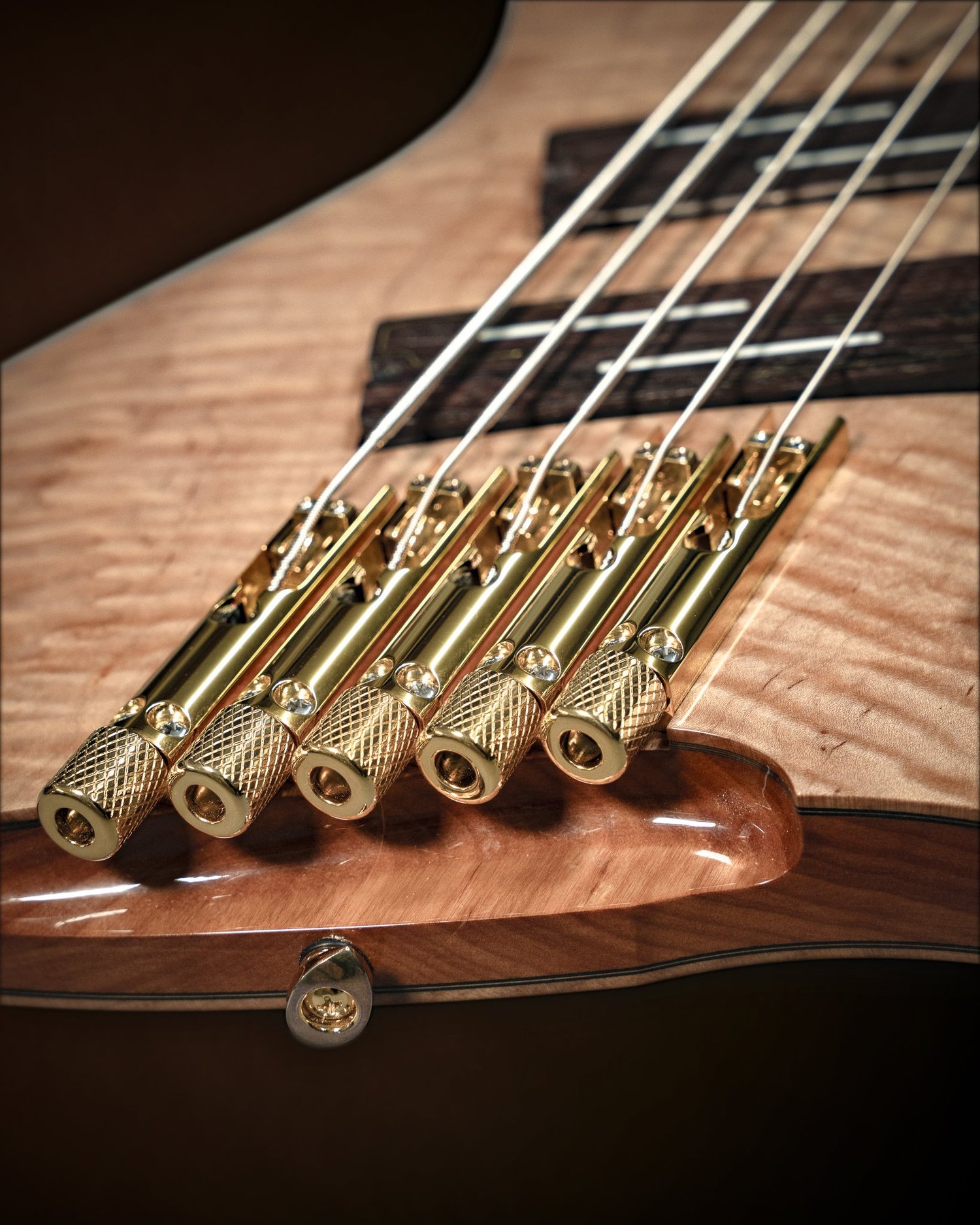
Because the Famine is headless, I can use individual bridge units instead of a conventional bridge mounted across one flat surface. The bottom of each bridge body is machined to sit directly on the 23.5-inch cylindrical top. That means the body itself already establishes much of the string radius before the saddle heights are adjusted.
On a flat mounting surface, the middle saddles have to sit noticeably higher than the outer saddles to create the correct arc across the strings. On the Famine, the bridge bodies are already stepped around the curved top. When the guitar is set up correctly, the individual saddles tend to sit at much more similar heights and retain similar amounts of adjustment travel.
I also just like the way that looks. Seeing all of the saddles sitting in roughly the same adjustment range is extremely satisfying. The bridge feels integrated into the geometry of the guitar instead of looking like hardware that was simply placed on top of it.
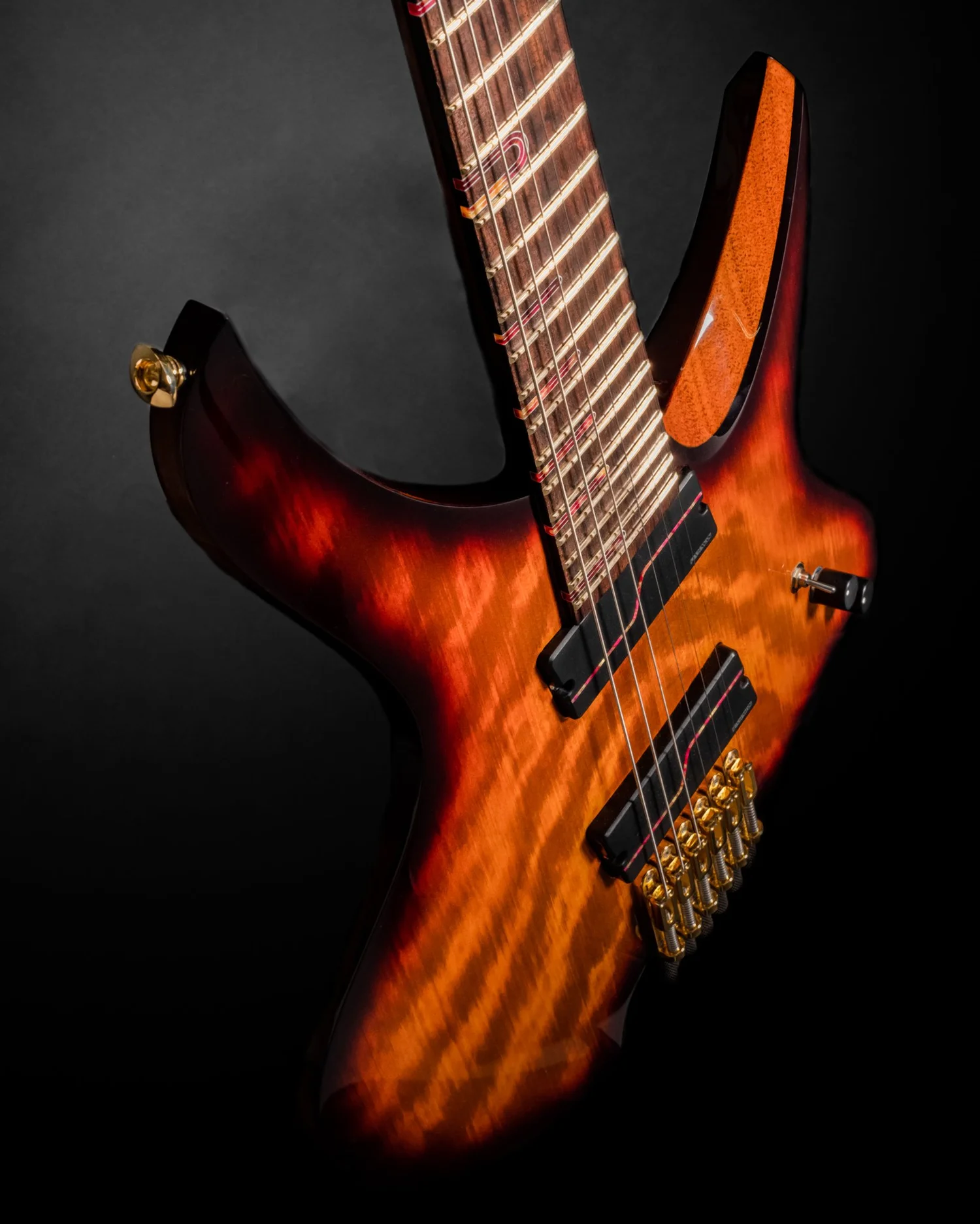
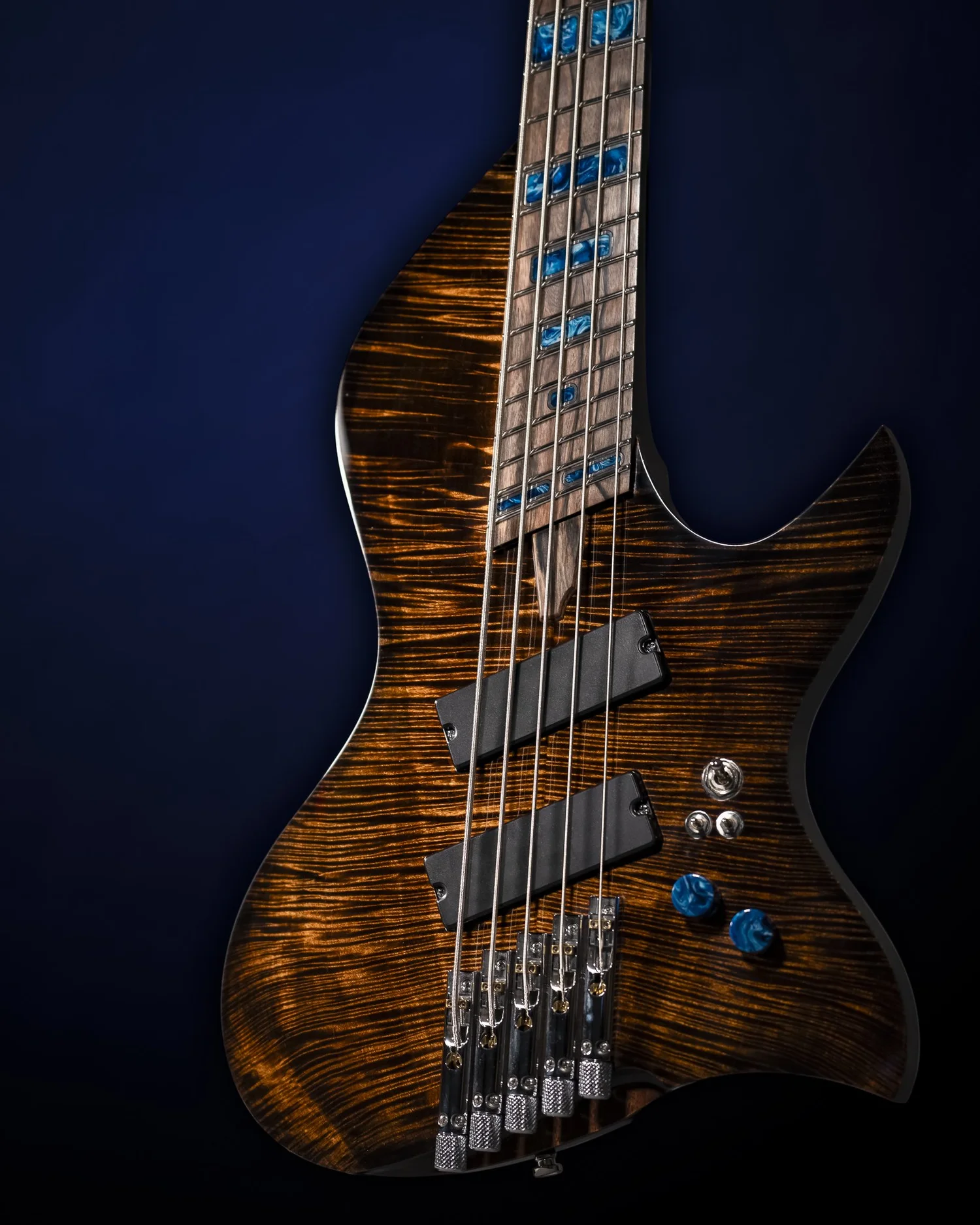
The Famine Bass
The Famine Bass uses the same basic idea, but I pushed the geometry farther.
The guitar has cylindrical surfaces. The top is 23.5 inches everywhere, and the back is 47 inches everywhere. The bass uses true conical surfaces.
Instead of projecting the compound fretboard radius to the bridge and then holding that number constant, the top of the bass continues the cone established by the fretboard itself. The radius keeps increasing as the surface moves farther down the length of the instrument.
Because of that, there is no single top-radius measurement that describes the whole bass body. The radius changes continuously from one end of the surface to the other.
The back follows the same conical progression at twice the corresponding radius of the top. At any given point along the length of the body, the back radius is double the top radius at that same position.
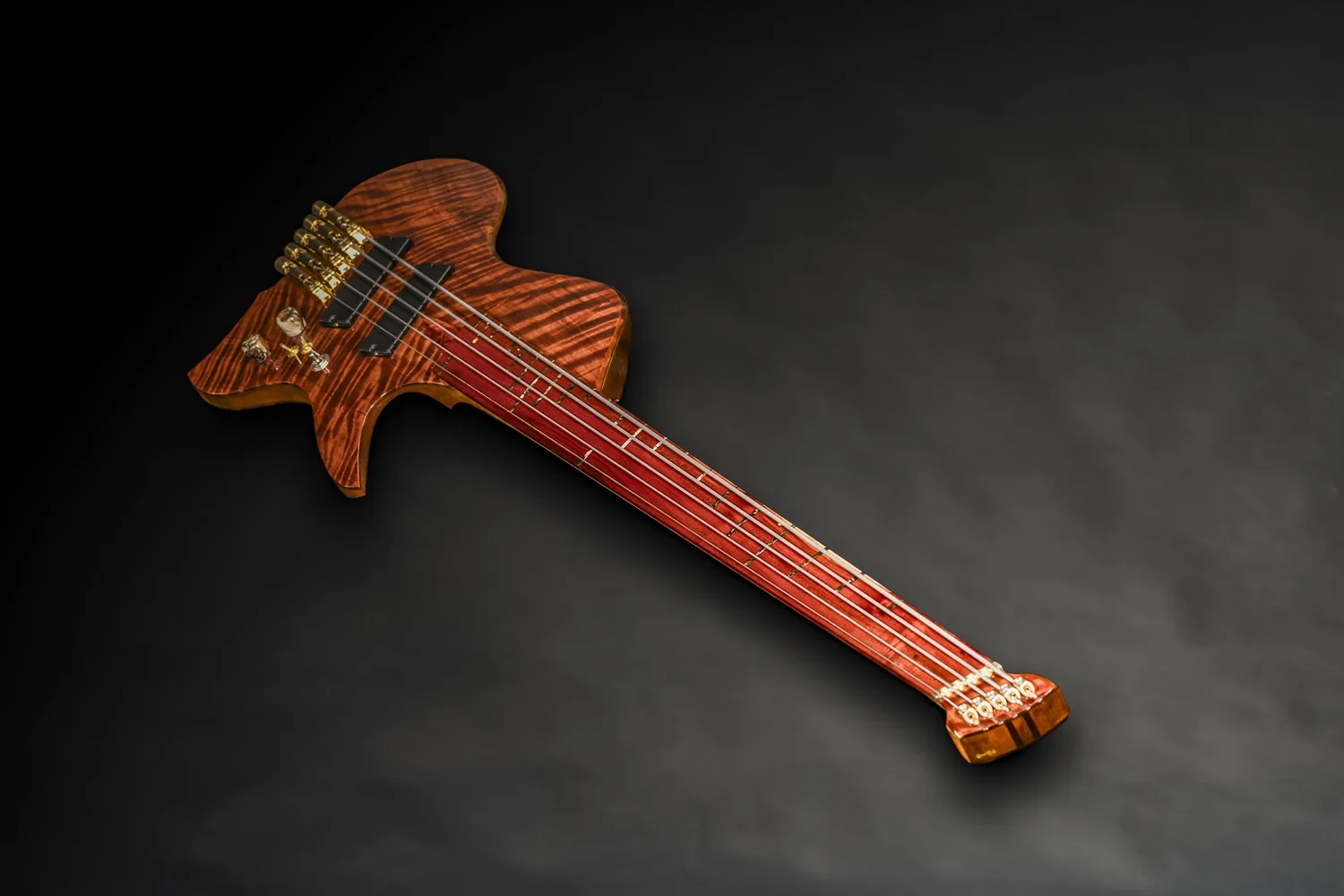
I got there mostly because I wanted to know whether it could be done. Once I had already built the cylindrical guitar, continuing the fretboard cone through the body seemed like the next step. I was curious what would happen if the bridge stopped being the point where the changing radius ended. The entire body could continue the same geometry, so that is what I did.
This is also where CAD and CNC become especially useful. None of these surfaces is impossible to make by hand, but accurately defining the cone, positioning parts on it, producing matching fixtures, and reproducing the geometry consistently would become tedious very quickly. In CAD, I can define the surface mathematically and work from that.
The Complication Is Everything That Has to Touch the Surface
Curved bodies make the manufacturing process more complicated because so much guitar building assumes flat reference surfaces.
A flat body is easy to fixture. It sits on a flat spoilboard or vacuum plate, the reference plane is obvious, and most operations are straightforward. Once the body is cylindrical or conical, the workholding has to match that geometry.
The vacuum fixtures for the Famine have to be machined to support the actual shape of the part. On the guitar, that means fixtures with matching cylindrical radii. On the bass, the fixtures have to conform to a conical surface.
That complicates the entire process. Parts have to be positioned on curved surfaces. Hardware has to be oriented properly relative to those surfaces. Machining operations need appropriate reference geometry. Even drawing the guitar becomes more tedious because you can no longer treat every feature as something sitting on a flat XY plane.
The bass makes this especially obvious because the surface under a component changes depending on where that component sits along the length of the body. Move something forward or backward and it is now sitting on a slightly different part of the cone.
There are much easier ways to build an electric guitar. I keep doing this because the result feels good and because I like the way the geometry ties the instrument together.
Old Ideas, Different Relationships
I would never claim that the cylindrical Famine body itself is a new invention. Howe-Orme was building cylindrical guitar tops in the nineteenth century. Rick Turner encountered those instruments, adapted the idea into the Model 1 in the 1970s, and I encountered it through working with Rick. That lineage is pretty straightforward.
What changed on the Famine was the reason for choosing the radius and the relationship between the body, fretboard, bridge, and hardware.
The 23.5-inch top came from projecting the compound-radius fretboard out to the bridge. Once I had that number, I used it to define the top surface and machined the bridge bodies to match it. The 47-inch back came from trying to create a gentler corresponding surface that would feel good against the player. The bass takes that same idea farther by continuing the actual fretboard cone through the body instead of fixing the radius at one number.
That is probably a fair example of how I think about guitar design in general. Most of the individual ideas already exist somewhere in the history of the instrument. What interests me is understanding them well enough to change the relationships between them and see what happens when one piece of geometry is allowed to influence the next.
The Famine is also a good example of form following function in a very literal way. I love designing guitars this way because it takes a surprising amount of the aesthetic decision-making out of my hands. The dimensions of the fretboard determine the bridge geometry. The bridge geometry influences the top. The top influences the hardware and the fixtures required to make the instrument. I can start with what the guitar needs to do and let those requirements shape the object.
That process has also led me to things I probably would never have drawn if I had started by asking what would look interesting. The 23.5-inch cylindrical top came from projecting a fretboard radius. The conical bass body came from wondering what would happen if I simply allowed that projection to continue. Neither began as a styling exercise. They came out of following the geometry and seeing where it led.
That is one of the reasons I enjoy building guitars this way. Function gives me constraints, and those constraints often define the form for me. Sometimes the result is familiar. Sometimes it makes something possible that I had never thought of until the geometry put it in front of me.
